






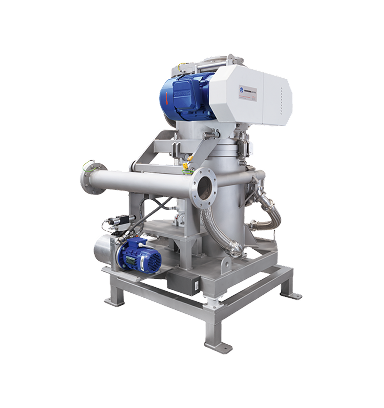
Jet Mill AFG
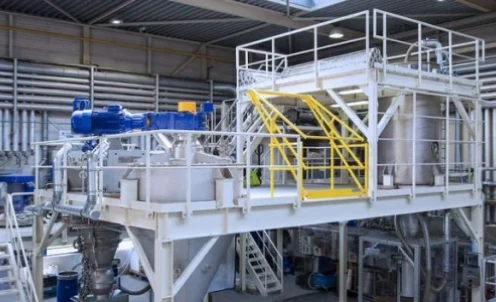
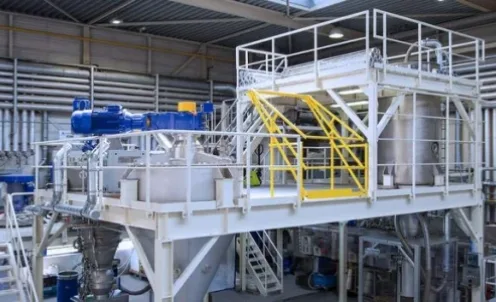
Hosokawa introduced the fluidized bed opposed jet mill onto the market in 1981, revolutionizing the sector of jet milling.
Principle of Operation
During expansion, the energy contained in the compressed gas in the form of heat is converted to kinetic energy. The speed of sound is initially a natural limit for the exit velocity. However by using Laval nozzles, the exit velocity can be increased to above the speed of sound. Laval nozzles are characterised by their hourglass shape, which widens downstream of the narrowest cross-sectional point, the nozzle throat.
The length of the divergent part of the nozzle is adapted to suit the operating pressure. Compressed air of 20°C and 6 bar overpressure is frequently used as the grinding gas, and delivers nozzle exit speeds of around 500 m/s. As a result of drawing in gas and product from the fluidised bed, the speed of the gas jets sinks extremely rapidly after exiting the nozzles. Comminution is a result of interparticle collision in the jets of air and also in the core area, i.e. the point where the opposing jets intersect.
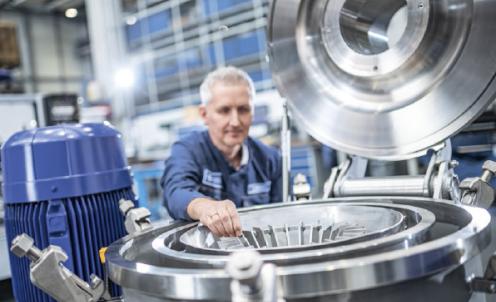
Jet mills are impact mills which are used to achieve maximum fineness values at maximum product purity. Such particle sizes can only be obtained in conjunction with an air classifying step. Spiral jet mills have a static air classifier integrated into the mill housing, whereas fluidised bed opposed jet mills are equipped with a dynamic deflector-wheel classifier.
The fineness is set as a function of the classifying wheel speed. All-important is a high product loading of the nozzle jets in order to achieve a high concentration of particles and thus high impact probabilities. The patented Megajet nozzles were developed with this in mind. They consist of four small nozzles which as a result of their close proximity generate an underpressure at their common centre, and thus draw particles from the fluidised bed direct into the centre of the nozzle jet. The product level in the machine is controlled by means of load cells or by monitoring the current loading of the classifier drive.
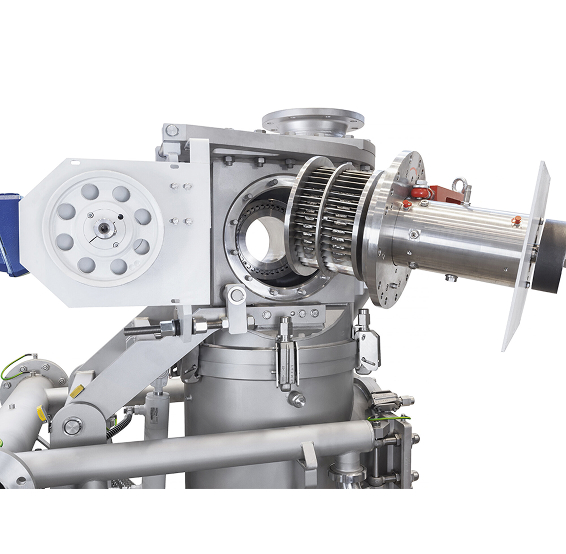
Features
Single-/multi-wheel classifier head
Monobloc ceramic classifying wheels ensure minimum wear when processing abrasive products
Lining: PU, ceramic or special-grade steel to suit the product
Stainless steel or mild steel, Ni alloy
Horizontal or 3D nozzle arrangement, Megajet nozzles
Selective milling, semi-batch mode, automatic quality control for high quality
Load cells for product level control
Material feed via a feed metering system into the classifier head or directly into the milling chamber, or injector feed
Explosion-pressure-shock-proof
Pharma design up to machine size 630/1 AFG, steep particle size distribution, high bioavailability for active substances, minimum off-spec batches, low manpower requirement
Hot-gas mode for mineral products permits cost-effective manufacture of large amounts of ultrafine mineral powders
Circuit-gas systems for pyrophoric products provide maximum safety
If frequent colour change is necessary, the TFG for coloured toner reduces costs and ensures optimum throughput rates
Specifications
| Model | Scale up factor | Product size d₉₇ | Nominal grinding air volume | No. grinding nozzles AFG | No. grinding nozzles AFG-R | Classifier type ATP | No. of classifying wheel | Motor | Wheel speed |
|---|---|---|---|---|---|---|---|---|---|
| 200/1 | 0.25 | 4~60 | 300 | 3 | 3 | 100 | 1 | 3 | 11500 |
| 280/1 | 0.5 | 4~100 | 600 | 3 | 3 | 140 | 1 | 4 | 8600 |
| 400/1 | 1 | 5~120 | 1200 | 3 | 4 | 200 | 1 | 5.5 | 6000 |
| 400/4 | 1 | 4~100 | 1200 | 3 | 4 | 100 | 4 | 12 | 11500 |
| 630/1 | 2.5 | 6~150 | 3000 | 4 | 5 | 315 | 1 | 11 | 4000 |
| 710/1 | 4 | 7~150 | 4800 | 4 | 5 | 400 | 1 | 15 | 3150 |
| 710/4 | 4 | 5~120 | 4800 | 4 | 5 | 200 | 4 | 22 | 6000 |
| 800/1 | 7 | 8~150 | 8400 | 4 | 5 | 500 | 1 | 30 | 2400 |
| 800/3 | 7 | 6~150 | 8400 | 4 | 5 | 315 | 3 | 33 | 4000 |
| 1000/1 | 10 | 9~200 | 12000 | 4 | 5 | 630 | 1 | 45 | 2000 |
| 1250/6 | 14 | 6~150 | 16800 | 4 | 5 | 315 | 6 | 90 | 4000 |
| 1500/3 | 21 | 8~150 | 22500 | 4 | 5 | 500 | 3 | 120 | 2400 |
experimental verification
Before investing in new equipment, please conduct tests on the materials to be used at the Hosokawa Testing and Process Development Center based on actual production conditions. Our experienced experts will assist you in determining the most effective mixing, granulation, or drying processes, helping you transition from laboratory trials to a comprehensive production testing phase. Whether you need to test the performance of a single machine or evaluate the entire production line, we can provide tailored testing services and process optimization solutions to ensure reliable system operation and excellent performance.
More

Contact Us
Feel free to contact us for any inquiries.